Fire Wall · Fire Barrier · Smoke Barrier · Smoke Partition
A Plans Reviewer's Field Guide to the Four Terms Practitioners Confuse Most
The vocabulary matters. A 'fire wall' on a set of as-builts is a different code requirement than a 'fire barrier,' and confusing them with smoke barriers and smoke partitions creates citations no facility wants. This guide explains the four in the order they appear on plan sets — plus four more specialized wall types (fire partitions, rated corridors, shaft walls, horizontal exits) contributed by Toby White, PE, LEED AP.

Miller Brown
Firefighter turned Fire Plans Review Manager. Career spans frontline fire service and AHJ-side plan review — reads buildings from both the rig and the desk. Off the clock: a drummer.
Why this article exists
Every code cycle I sit across the desk from a contractor who calls a wall by the wrong name. Not because they don’t know construction — they do — but because the four terms in the title of this article look interchangeable to the eye. They aren’t. Each one has a different design intent, a different test standard, a different code section, and a different set of consequences when it’s wrong.
I came up on the line first. You learn the same lesson in a structure fire that you learn at the plan review desk: a wall that looks heavy can fail in 12 minutes if its rating doesn’t match what’s drawn. A wall that looks ordinary can hold a stairwell tenable for hours because somebody knew the difference between a smoke partition and a smoke barrier. The vocabulary in the four bolded headings below is the difference between those two outcomes.
This is a working reference, not a treatise. Use it when a plan set crosses your desk, when a tenant improvement wraps in 30 days, or when you’re standing in front of a CMS surveyor explaining why the corridor wall is labeled the way it is. The four sections below appear in the order they show up on a typical life-safety drawing.
1. Fire Wall
A wall separating buildings or subdividing a building to prevent the spread of fire and having a fire-resistance rating and structural stability. NFPA 921
A fire wall is the most robust assembly in this conversation. It exists to do something the other three don’t: survive the collapse of the construction on either side without itself failing. That structural-independence requirement is what separates a fire wall from every other rated assembly in the code. NFPA 221 + IBC §706 are the controlling documents.
Fire walls are commonly used to split a single physical structure into separate buildings for code purposes. Each “building” on either side of a fire wall is analyzed independently for occupancy, allowable height, allowable area, and exit count. That’s the leverage of a fire wall: it’s a code-analysis tool first, a fire-spread barrier second.
What I look for on plans: a fire wall is shown with a heavy line weight + a code reference to NFPA 221 OR IBC §706 in the wall schedule. The detail must show the parapet (or approved alternative), the structural-stability provisions, and how the wall continues through every floor and roof of the structure without dependence on the framing on either side. If a wall is labeled “fire wall” but the detail shows it terminating at a suspended ceiling or sharing structural support with the framing on one side, it’s not a fire wall — whatever the label says.
2. Fire Barrier
A continuous membrane or a membrane with discontinuities created by protected openings with a specified fire protection rating, where such membrane is designed and constructed with a specified fire-resistance rating to limit the spread of fire. NFPA 101 §3.3.36
A fire barrier is the workhorse fire-rated wall in most buildings. Unlike a fire wall, it doesn’t need to stand independent of the building’s structure — it leans on the structure around it for support. What it MUST do is achieve its rated fire-resistance period (typically 1, 2, 3, or 4 hours) and resist the passage of direct flame and significant heat for that period under ASTM E119 test conditions.
Fire barriers form the boundaries of fire compartments inside a building: stairs, shafts, fire areas in mixed occupancies, hazardous-area enclosures, separations between occupancies, and the perimeters around exit-access corridors in some occupancies. NFPA 101 §8.3 + IBC §707 control them.
What I look for on plans: a wall labeled “1-hour fire barrier” (or 2-hr, etc.) with the rating shown in the wall schedule, a UL design number or tested assembly reference for the wall construction, AND opening protectives (doors, windows, dampers) rated to match the wall rating per IBC Table 716.1. A 1-hour fire barrier with a 45-minute door is not a 1-hour fire barrier. It is a 45-minute barrier — the weakest link in any chain.
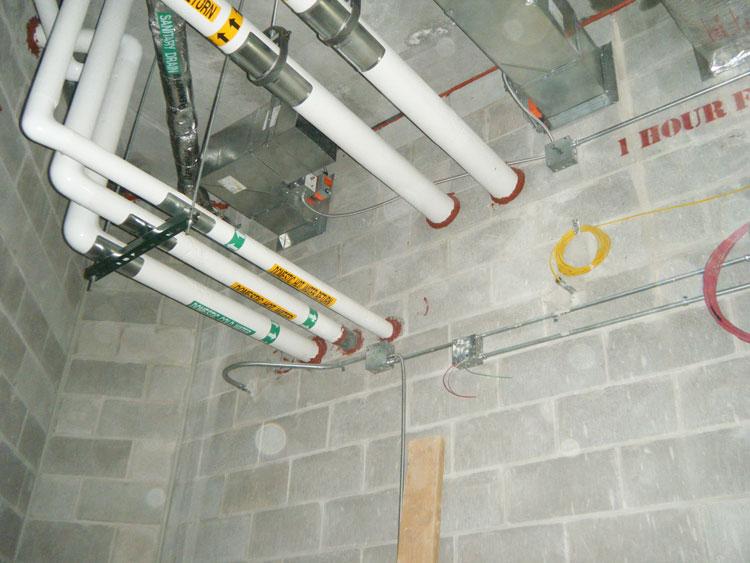
3. Smoke Barrier
A continuous membrane, or a membrane with discontinuities created by protected openings, where such membrane is designed and constructed to restrict the movement of smoke. NFPA 101 §3.3.250
A smoke barrier subdivides spaces to restrict the movement of smoke — the same defend-in-place strategy that drives healthcare and detention occupancy design. In healthcare specifically, every floor must be subdivided into smoke compartments of no more than 22,500 sq ft (NFPA 101 §18.3.7 / §19.3.7), and the membrane that creates those compartments is a smoke barrier.
Here’s where the terminology gets sticky: smoke barriers are classified by their smoke-tightness property, not by a fire-resistance duration. But in most applications — including the healthcare and detention chapters that reference them most often — the smoke barrier is also REQUIRED to be a 1-hour fire-rated assembly. So in the field, a smoke barrier in a hospital is usually both: smoke-tight AND 1-hour fire-rated. In an atrium application, it may be smoke-tight only.
Plain language: a smoke barrier is for smoke first; in healthcare, it’s a fire-rated assembly too. Not every smoke barrier is a fire barrier, and not every fire barrier is a smoke barrier. The two categories overlap but they don’t define each other.
What I look for on plans: a wall labeled “smoke barrier” with smoke-tightness construction shown (slab-to-slab continuity, no penetrations without listed sealant systems, smoke dampers at duct penetrations per NFPA 101 §8.5.5), plus the fire-resistance rating if the occupancy chapter requires it. Cross-corridor doors must self-close + self-latch and meet smoke-leakage per UL 1784. K-tag K-0372 cites breaches in smoke compartmentation; it traces directly to smoke-barrier construction here.
4. Smoke Partition
A continuous membrane that is designed to form a barrier to limit the transfer of smoke. NFPA 101 §3.3.243
The lightest assembly of the four. A smoke partition is designed to limit — not necessarily prevent — smoke transfer. The intent is to slow smoke migration enough that the building’s detection, suppression, and egress systems have time to do their job, not to seal smoke out completely.
Smoke partitions are not generally required to be fire-rated, and they don’t typically require smoke dampers at duct penetrations — the two big technical distinctions from a smoke barrier. They CAN stop at a smoke-tight ceiling instead of going full slab-to-slab the way a smoke barrier must.
The most common smoke-partition application is the healthcare corridor wall in a fully-sprinklered new building. Under NFPA 101 §18.3.6.1 exceptions, the corridor walls in a sprinklered new healthcare building are smoke partitions — not the smoke barriers many people assume they are. Different construction requirements, different penetration requirements, different damper requirements. Getting this distinction right matters enormously when a hospital is preparing for a CMS Life Safety survey.
What I look for on plans: a smoke partition shown with a continuous wall from floor to either the deck above OR a smoke-tight ceiling; doors meeting UL 1784 smoke-leakage limits; self-closing devices on the doors. NO fire-resistance rating is required unless the occupancy chapter specifically calls for one (which most don’t for a smoke partition).
Key Summary Table
| Type | Limits Fire | Limits Smoke | Fire-Resistance Required | Notes |
|---|---|---|---|---|
| Fire Wall | Yes | Yes | Yes (most stringent) | Subdivides into separate buildings; must remain intact if collapse on one side |
| Fire Barrier | Yes | Usually | Yes | For compartmentation; rated; must withstand direct fire impingement |
| Smoke Barrier | No* | Yes | Sometimes | For smoke compartmentation / defend-in-place; sometimes also fire-rated |
| Smoke Partition | No | Limited | Not required | Minimally restricts smoke; not a rated assembly; no dampers required for ducts |
*Some smoke barriers ARE required to be fire-rated depending on the occupancy and application — see the smoke-barrier section above.
Further Clarifications — What Surveyors and Plans Reviewers Cite
A smoke partition that limits the transfer of smoke is different from a smoke barrier that restricts smoke movement from one side of the barrier to the other… A smoke partition should be thought of as a barrier that reasonably limits, but does not necessarily prevent, smoke transfer.
The difference between limit and restrict in those two definitions is the entire technical gap between a smoke partition and a smoke barrier. Plans reviewers who’ve been doing this a while read “limit” as “slow it down enough for the active systems to do their job” and “restrict” as “keep it from crossing for the duration of the defend-in-place sequence.”
It is imprecise to refer to a “1-hour smoke barrier,” because smoke barriers are not classified based on the duration for which they resist the transfer of smoke. It is more accurate to refer to a “smoke barrier that additionally has a 1-hour fire-resistance rating.” A barrier with only a fire-resistance rating does not necessarily make an effective smoke barrier.
This is the language correction I make most often. Once you start saying it out loud the right way — “smoke barrier with a 1-hour fire-resistance rating” rather than “1-hour smoke barrier” — the rest of the code conversation gets clearer. A fire-rating belongs to ASTM E119. A smoke-tightness property belongs to the construction details and to UL 1784 for the openings. They’re different attributes, and they’re tested differently.
5. Beyond the Big Four — A Reviewer Note from Toby White, PE
Toby White, PE, LEED AP
Professional Engineer + LEED-accredited reviewer. Suggested adding fire partitions, rated corridors, shaft walls, and horizontal exits as additional wall-type categories practitioners regularly conflate with the “Big Four.” The four sub-sections below are written in response to his note. LinkedIn ↗
Toby’s point is well taken. The four wall types covered above (fire wall · fire barrier · smoke barrier · smoke partition) are the ones plans reviewers most often see CONFUSED with each other, but they aren’t the complete taxonomy of rated assemblies you’ll encounter on a working drawing set. Four more categories show up frequently enough that they deserve the same precision treatment — each governed by its own IBC section, each with a different continuity rule, each with different opening-protective requirements.
5a. Fire Partitions IBC §708
Fire partitions are a separate IBC category from fire barriers — different section, different continuity rule, typically lower rating. They’re the rated assembly the code uses for dwelling-unit separations in apartments (R-2), guestroom separations in hotels, tenant separations in mall buildings, elevator-lobby separations in some configurations, and (importantly) the walls forming a rated corridor in most non-healthcare occupancies. Typical rating is 1 hour; sprinklered R-2 apartments drop to ½-hour for unit-to-unit separations per IBC §708.3 exceptions.
The structural distinction from a fire barrier is the continuity rule in IBC §708.4: a fire partition may terminate at the underside of a fire-resistance-rated floor/ceiling assembly OR a fire-rated horizontal assembly — it does NOT have to extend to the deck above. A fire barrier (§707.5) must extend through concealed spaces to the underside of the floor or roof deck. That one distinction drives most of the construction differences: a fire partition can stop at a rated ceiling; a fire barrier cannot.
What I look for on plans: a wall labeled “1-hour fire partition” with the rated-ceiling reference in the wall schedule (e.g., “extends to UL L506 floor/ceiling assembly above”) OR a slab-to-slab note. Opening protectives in a 1-hour fire partition typically need a 20-minute fire-protection rating per IBC Table 716.1 (3) — lighter than the 45-minute door in a 1-hour fire barrier. Calling a fire partition a “fire barrier” on as-builts overstates the assembly and creates downstream confusion: a future contractor doing a tenant fit-out may select firestop products and opening protectives at the wrong rating, then assume the wall meets a standard it was never designed for.
5b. Rated Corridors IBC §1020 NFPA 101 §7.1.3.2.1
“Rated corridor” is an APPLICATION, not a wall-type classification — this is the distinction Toby singled out. The corridor itself is a means-of-egress concept under IBC Chapter 10; what makes it “rated” is that the surrounding walls have a required fire-resistance rating. The wall TYPE forming those corridor walls is one of the categories above: a fire partition in most office and residential occupancies (IBC §708), or a fire barrier in healthcare and detention occupancies (IBC §707, NFPA 101 §18.3.6 with its many exceptions).
The determining table is IBC Table 1020.2 (older code editions had this as 1020.1 or 1018.1). It lists every occupancy classification, the minimum occupant load that triggers a rating requirement, and whether sprinklers reduce or eliminate that requirement. The biggest practical example: a fully-sprinklered Group B (business) occupancy generally has NO required corridor rating regardless of occupant load — which is why open-plan offices in sprinklered buildings can use ½-hour smoke-resistive partitions rather than 1-hour rated walls. Conversely, a non-sprinklered B occupancy above 30 occupants requires a 1-hour rated corridor.
What I look for on plans: the corridor wall labeled with both its assembly TYPE (fire partition or fire barrier) AND its rating (1-hour, ½-hour, etc.), plus the IBC Table 1020.2 reference for the rating decision. Doors in rated corridors get a 20-minute fire-protection rating with smoke-leakage testing per UL 1784. NFPA 101 §7.1.3.2.1 has parallel provisions, with the additional nuance that life-safety design under NFPA 101 may require a corridor rating even when the IBC doesn’t — healthcare being the most common case.
The healthcare-specific corridor-wall conversation belongs back in §4 above (smoke partitions under §18.3.6 exceptions). That’s a different code path from a generic rated corridor and reinforces Toby’s point about precision: the same architectural feature (a corridor wall) can be a smoke partition, a fire partition, OR a fire barrier depending on the occupancy, the sprinkler status, and the adopted code edition. The label must match the wall’s code basis, not the visual appearance.
5c. Shaft Walls IBC §713 NFPA 101 §8.6
A shaft wall is fire-barrier construction governed by IBC §713 — the section specifically calls out that shaft enclosures “shall be constructed as fire barriers in accordance with §707 or horizontal assemblies in accordance with §711.” The required rating depends on the number of stories the shaft connects: 1 hour for shafts connecting fewer than 4 stories, 2 hours for 4 or more stories (IBC §713.4). NFPA 101 §8.6 uses the parallel “vertical opening” terminology and the same general rating logic.
Three features distinguish shaft walls from generic interior fire barriers in the field:
- Assembly type. Shaft walls are usually built from one side (you can’t access the inside of the shaft once it’s framed). The industry standard is the UL U415 / V415 shaft-wall liner system — a 1-inch gypsum liner panel installed in C-H or J-track studs from the corridor side, with finish layers applied to the corridor face afterward. Several other UL designs (U459, W403, etc.) cover variants.
- Strict continuity. The shaft enclosure must be continuous from foundation to roof deck, with every floor penetration sealed by a listed shaft-floor firestop assembly. Skipping continuity at even one floor compromises the entire vertical assembly.
- Opening protectives. Doors at shaft openings (stair-tower doors, elevator-lobby doors, refuse-chute access doors) get 60-minute or 90-minute fire ratings per the wall rating, with self-closing and self-latching hardware. Stair shafts also have positive-pressure smoke control in many high-rise applications — see the Stairwell Pressurization article for IBC §909.20 details.
What I look for on plans: the wall schedule must show the specific UL design number for the shaft-wall assembly (U415 etc.), the rating (1 or 2 hour) tied to the IBC §713.4 story-count rule, and the continuity detail at every floor/ceiling intersection. Penetrations through shaft walls are the single highest-leverage firestop inspection point in a tall building — one bad penetration in a 30-story stair shaft compromises the defend-in-place strategy for the entire structure.
5d. Horizontal Exits IBC §1026 NFPA 101 §7.2.4
A horizontal exit is an exit through a fire-resistance-rated wall into an adjacent compartment of the same building (or an adjacent building) that is considered a refuge area. Unlike a stair (which moves occupants vertically to a discharge point) or an exterior exit door (which moves them outside), a horizontal exit moves them HORIZONTALLY into a separately-protected compartment. The receiving compartment is treated as a defend-in-place destination — for hospital occupants in beds, for detention occupants whose movement is restricted, or for high-rise occupants where descending the stair would take too long for the threat profile.
The separating wall is the load-bearing element of this design. Per NFPA 101 §7.2.4.3.1 and IBC §1026.2, the wall providing a horizontal exit must be a fire barrier with at least a 2-hour fire-resistance rating, continuous from the foundation to the underside of the floor or roof above. Doors in the wall are 1.5-hour (90-minute) fire-protection-rated, self-closing, and equipped with hardware that allows easy passage in the direction of egress. Glass openings, ductwork penetrations, and other discontinuities all have to maintain that 2-hour assembly rating.
The capacity rule that trips designers up: each compartment on either side of the horizontal exit must be sized to hold ALL the occupants of BOTH sides under the §7.2.4 logic — the originating-side occupants are still using the receiving compartment as their exit, AND the receiving-side occupants are still there. Per NFPA 101 §7.2.4.3.5, each compartment’s capacity must equal the combined occupant load divided by the floor area available in that compartment (with the 3-sq-ft-per-person rule for ambulatory occupants, 15 sq ft/person for non-ambulatory bed-bound healthcare).
Where you’ll see them most: healthcare. NFPA 101 §18.2.2.5 / §19.2.2.5 explicitly allow horizontal exits to substitute for up to half of the required exits on a hospital floor — rolling beds through a 90-minute door into the adjacent smoke compartment is faster and safer than evacuating them down a stair. Detention occupancies (§22.2.2.5 / §23.2.2.5) lean on horizontal exits even more heavily for the same reason. High-rise office buildings sometimes use them between stair towers on assembly-occupancy floors. Large mercantile buildings occasionally use them to satisfy mall-tenant exit requirements without rebuilding the structural shell.
What I look for on plans: the horizontal-exit wall labeled as a 2-hour fire barrier with the IBC §1026 / NFPA 101 §7.2.4 reference; the 90-minute door scheduled at the opening with appropriate hardware; the capacity calculation shown for BOTH compartments demonstrating that each can hold the combined occupant load; AND the area-of-refuge designation noted on the life-safety plan if applicable. Missing capacity calculations on the drawings are the most common deficiency I write back to designers for.
Extended Summary — Eight Wall Types You’ll See on Plans
| Type | IBC § | NFPA 101 § | Typical Rating | Continuity | Most-Common Use |
|---|---|---|---|---|---|
| Fire Wall | §706 | — | 2–4 hr | Structurally independent | Subdivides a structure into separate “buildings” for code |
| Fire Barrier | §707 | §8.3 | 1–4 hr | Slab-to-slab (or to rated horizontal) | Compartmentation, shaft enclosure, occupancy separation |
| Fire Partition | §708 | — | ½–1 hr | May stop at rated ceiling | Apartment / hotel / tenant separations, corridor walls |
| Smoke Barrier | §711 | §8.5 | Often 1 hr | Slab-to-slab, smoke-tight | Smoke compartmentation (healthcare, detention defend-in-place) |
| Smoke Partition | §710 | §8.4 | Usually unrated | May stop at smoke-tight ceiling | Sprinklered healthcare corridor walls, atrium subdivisions |
| Rated Corridor | §1020 | §7.1.3.2.1 | ½–1 hr | Application — uses §707 or §708 walls | Means-of-egress per Table 1020.2 (occupant-load + sprinkler trigger) |
| Shaft Wall | §713 | §8.6 | 1 hr (<4 stories), 2 hr (4+ stories) | Foundation to roof, single-side install | Stair towers, elevator shafts, mechanical chases, refuse chutes |
| Horizontal Exit | §1026 | §7.2.4 | 2 hr fire barrier, 90-min door | Foundation to roof, full assembly | Healthcare, detention, high-rise — exit by horizontal compartment |
Citations apply to the current published editions of IBC and NFPA 101. State-adopted editions may lag — check the State Code Checker tool in this wiki for the edition adopted in your jurisdiction. Healthcare facilities additionally comply with the CMS-adopted 2012 edition of NFPA 101 where it’s more restrictive.
6. When Modifications Trigger New-Construction Compliance — NFPA 101 Chapter 43
Chapter 43 defines six categories of rehabilitation work, each with progressively more stringent compliance triggers. The category your project falls into determines whether the existing wall stays under the “existing” chapter (lighter requirements, grandfathered) or has to come up to the “new” chapter standard (potentially a different rating, different opening protectives, different penetration sealing). For a 50-year-old hospital corridor wall that’s been compliant with Chapter 19 since the building opened, a single tenant fit-out classified as a Modification can force the affected wall section to meet Chapter 18 requirements — which may mean upgrading to a 1-hour fire barrier with smoke-resistive doors where the existing wall was a non-rated partition.
The Six Work Categories
| Category | NFPA 101 § | Definition (paraphrased) | Compliance trigger |
|---|---|---|---|
| Repair | 43.3 | Patching, restoration, replacement of damaged or deteriorated materials with similar materials | Existing chapter governs. Materials used must comply with applicable provisions for new construction, but the assembly stays under the existing-chapter rating. |
| Renovation | 43.4 | Replacement in kind, strengthening, or upgrading of existing materials/elements/equipment without reconfiguring spaces | Existing chapter governs. Replacement materials must meet current code for the type of material installed. |
| Modification | 43.5 | Reconfiguration of any space; addition, elimination, or relocation of doors/windows; reconfiguration or extension of any system; installation of additional equipment | Affected portions comply with new-construction chapter. Unaffected portions stay under existing. This is the most common trigger in occupied tenant-fit-out work. |
| Reconstruction | 43.6 | Reconfiguration of any space that affects an exit or shared egress; OR modification work that exceeds a threshold percentage of the area | Work area complies with new-construction chapter + sprinkler retrofit triggers may apply per the occupancy chapter (e.g., NFPA 101 §19.3.5.1 for existing healthcare). |
| Change of Use | 43.7 | Building or portion of building changes occupancy classification or hazard category | Affected portion complies with the new occupancy chapter at the higher hazard. Lower-to-higher hazard moves (e.g., office → clinic) are the most common citation pattern. |
| Addition | 43.8 | Increase in building area, height, or stories | Addition complies with new-construction chapter. The existing portion stays under existing UNLESS the addition exceeds defined thresholds, in which case the entire structure may need to be evaluated against new construction. |
What This Means for the Eight Wall Types Above
Every wall in the extended summary table is grandfathered under the existing-occupancy chapter UNTIL one of these work categories touches it. Three concrete examples:
- Existing healthcare smoke partition (Ch 19) → Modification work in the adjacent suite. Under Chapter 19 the corridor wall may be a smoke partition with relatively light requirements. If the modification touches that section of corridor (new door, new penetration, reconfiguration), §43.5 generally requires that affected portion to comply with Chapter 18 (new healthcare) — which in many sprinklered new-healthcare buildings is also a smoke partition under §18.3.6.1, so the assembly type may not change. BUT the door rating, the smoke-leakage requirement, and the penetration firestop all need to come up to Chapter 18 spec for the affected length of wall.
- Existing fire partition between two apartments (Ch 31) → Reconstruction. A gut renovation of one unit that affects more than the minor scope of §43.5 typically falls into §43.6 Reconstruction. The unit-to-unit fire partition then has to be evaluated against Chapter 30 (new apartments) — which may require a 1-hour rating where the existing wall was ½-hour, plus updated penetration firestop, updated door rating, etc. NFPA 101 §43.6.1.2 also activates the sprinkler-trigger language.
- Existing office space (Ch 39 Business) → Change of Use to outpatient surgery (Ch 20 Ambulatory Healthcare). §43.7 is unforgiving here. Every wall in the converted area — corridors, hazardous-area separations, the perimeter of the suite — must be evaluated against Chapter 20 (the more restrictive new-occupancy chapter). This is where existing fire partitions get re-evaluated against Chapter 20’s fire-barrier requirements and frequently fail. Owners doing MOB-to-ASC conversions routinely under-budget for this work.
- Replacing a fire-rated door in an existing 1-hour fire barrier → Repair (§43.3). Listed assembly, replacement-in-kind, same rating, same opening size, same hardware listing — this is the clean case. No Chapter-43 trigger. The wall stays under the existing-occupancy chapter, the new door inherits the existing rating. The thing that turns this from §43.3 to §43.5 Modification is widening the opening, changing the rating, or adding a sidelite — ANY reconfiguration. Documentation matters: keep the new door’s UL listing label, the installer’s certification, and a photo of the closer + smoke seal in the closeout file. Surveyors check the listing label against the wall rating noted on the LSP.
- New MRI suite added to an existing hospital → Addition (§43.8). The new square footage is built to Chapter 18 (new healthcare); the existing wing stays under Chapter 19. The interface between old and new typically requires a 2-hour fire barrier per §18.1.6 construction-type rules — and the rating of THAT specific wall is the most-cited shortcut on these projects. Plans get drawn with the interface as a 1-hour assembly carried over from the existing Chapter-19 corridor, the AHJ catches it during plan review, the design changes, schedule slips. Specify the interface barrier at the Chapter 18 rating from day one and the project flows.
A Change of Use (§43.7) that crosses the ambulatory-healthcare threshold — 4+ outpatients incapable of self-preservation, or any general anesthesia per Ch 6 — drags the entire converted suite into Chapter 20 / Chapter 38 jurisdiction depending on the occupancy split. CMS surveyors check K-322 (Construction Type) and K-321 (Hazardous Areas) against the chapter that applies to the converted use, not the building’s original chapter.
Discovery during a CMS survey is the worst case. Retrofit-to-comply costs on a finished build-out can run into six figures — corridor walls torn open to upgrade ratings, hazardous-area separations rebuilt, soiled-utility rooms re-enclosed, doors swapped to 90-min Class B from whatever the office had. Add the survey-finding remediation timeline and the facility may operate under a Plan of Correction for months.
Catch it at design. The single highest-leverage move on any office-to-clinical conversion is a Chapter-43 classification meeting with the AHJ + facility CHFM + the FPE BEFORE the construction documents are stamped. The chapter that governs the converted suite has to be decided up front; everything downstream follows from that one decision.
The CMS Healthcare Wrinkle
For Medicare-billing healthcare facilities, the CMS-adopted edition is NFPA 101 (2012). Chapter 43 in the 2012 edition has the same six-category structure, but the cross-references go to Chapter 18 (new healthcare) and Chapter 19 (existing healthcare) of the 2012 edition. When the state fire marshal adopts a newer edition with revised Chapter 43 thresholds, the healthcare facility complies with BOTH — the state-adopted edition for state purposes, and the 2012 edition for CMS purposes. Where the two disagree, the more restrictive of the two governs. This is the same dual-regulation rule covered in NFPA 101 §1.6 enforcement.
What I Look For on Plans When Rehab Is Involved
The single most useful thing on a rehabilitation submittal is an explicit Chapter 43 classification note on the cover sheet or life-safety plan: “Work is classified as §43.5 Modification per NFPA 101 (2024 edition).” Once that’s on the drawings, every reviewer reading the set understands which chapter the affected walls comply with and the wall schedule can be checked against the correct requirements. Submittals without the classification note force the reviewer to derive it — and reviewers who guess wrong waste cycles in revision rounds.
The second thing: a scope-of-work boundary drawn on the life-safety plan, separating the affected portion (complying with the new-construction chapter) from the unaffected portion (staying under the existing chapter). For partial-floor renovations especially, this boundary determines exactly where the wall-rating requirements change — and the wall schedule should call out the change explicitly (e.g., “wall type A within scope area; wall type B outside scope area; transition at gridline X.4”).
The third: if there’s any chance the work qualifies as Reconstruction (§43.6) or Change of Use (§43.7), get an FSES (NFPA 101A) evaluation on file early. The Fire Safety Evaluation System lets healthcare facilities document compensating features (sprinklers, alarm upgrade, etc.) that score against specific deficiencies in the existing assembly. A passing FSES score — covered in §1.4 Equivalency — can preserve an existing wall configuration that would otherwise need to be torn out and rebuilt to meet a new-construction rating.
One Practical Rule for Anyone Maintaining a Building
When you renovate, when you re-fit a tenant space, when you add a single penetration through an existing wall — find out what kind of wall it is before you touch it. The labels on the existing as-builts may be wrong (we’ve covered why above). The accurate way to verify is to pull the original life-safety drawings + wall schedule from the building’s permit file, OR to have a fire-protection engineer or qualified plans reviewer assess the wall in place.
A new penetration through an unrecognized fire barrier is the kind of mistake that doesn’t show up for years — until someone above the ceiling notices the missing firestop and writes a citation, or worse, until a fire propagates through the un-sealed penetration when it shouldn’t have. Knowing which of these four wall types you’re working on is the first move every time.
Frequently Asked Questions
What is the difference between a fire wall and a fire barrier?
Can a smoke barrier also be a fire barrier?
Do smoke partitions need smoke dampers at duct penetrations?
Where do plans reviewers look first to verify these distinctions?
Why does this terminology trip up so many people in the field?
What's the difference between a fire BARRIER and a fire PARTITION?
Is a 'rated corridor' a separate wall type in the code?
What makes a shaft wall different from a regular fire barrier?
What is a horizontal exit, and why is it considered an 'exit' if you don't go outside?
When does a modification to an existing wall require it to meet NEW-construction requirements?
If I renovate an old building, do I have to bring every wall up to current code?
We curate a vetted network of approved vendors so you get one relationship instead of chasing five contracts — or let an analyst run your whole compliance calendar automatically, reports audited on arrival.
References
1. NFPA 101 (current edition): Life Safety Code, §1.4 Equivalency, §7.1.3.2 Construction of Means of Egress, §7.2.4 Horizontal Exits, §8.3 Fire Barriers, §8.4 Smoke Partitions, §8.5 Smoke Barriers, §8.6 Vertical Openings, §43.3–§43.8 Building Rehabilitation (Repair, Renovation, Modification, Reconstruction, Change of Use, Addition).
1a. NFPA 101A: Guide on Alternative Approaches to Life Safety — the FSES (Fire Safety Evaluation System) worksheets referenced in §1.4 equivalency findings, used to document compensating features that preserve existing wall configurations during rehabilitation.
2. NFPA 221: Standard for High Challenge Fire Walls, Fire Walls, and Fire Barrier Walls.
3. International Building Code (current edition): §706 Fire Walls, §707 Fire Barriers, §708 Fire Partitions, §710 Smoke Partitions, §711 Smoke Barriers, §713 Shaft Enclosures, §1020 Corridors, §1026 Horizontal Exits.
4. ASTM E119 / UL 263: Standard Test Methods for Fire Tests of Building Construction and Materials — the fire-resistance test that all fire walls / fire barriers / fire-rated smoke barriers reference.
5. UL 1784: Standard for Air Leakage Tests of Door Assemblies and Other Opening Protectives — the smoke-leakage test applied to doors in smoke partitions + smoke barriers.
6. NFPA 921: Guide for Fire and Explosion Investigations, definitional reference for fire walls in post-incident investigation context.
7. IBC Table 1020.2 (formerly Table 1020.1 in older editions): Corridor Fire-Resistance Rating — the determining table for when corridors must be rated, by occupancy and sprinkler status.
8. UL U415 / V415 series: Shaft Wall Assembly designs — the gypsum liner panel system commonly used for stair, elevator, and mechanical shafts.
Open the discussion panel to comment, flag an inaccuracy, add field experience, or ask a question. Approved contributions earn SRP and may be incorporated into the article.